


 Back to all
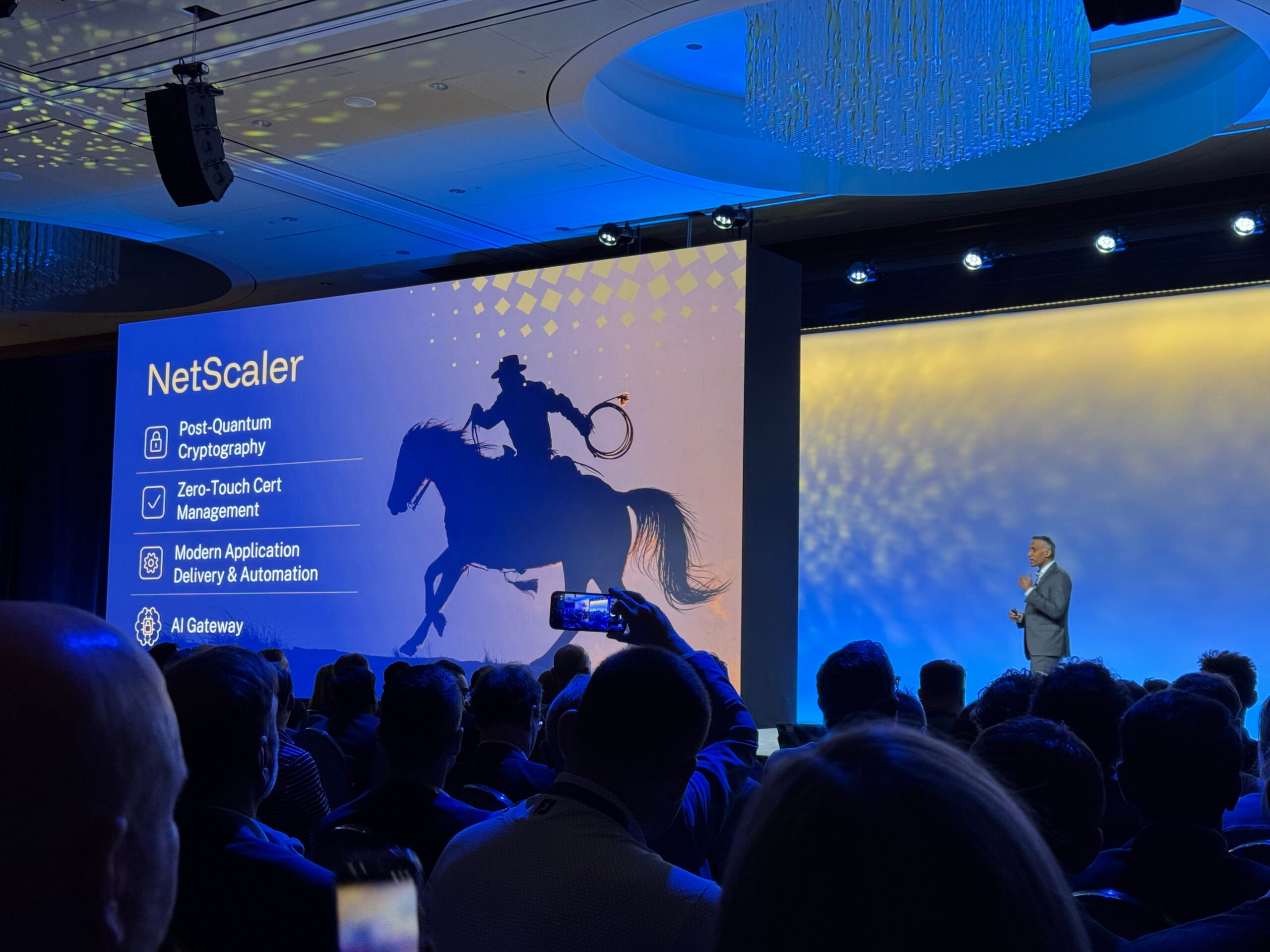
After already attending an eLux and Scout training session this year, our End User Computing Specialist, Stephan Stickley went even further, as he and our Sales Director, Will Lingard travelled to the US for Citrix UNITE.
There were lots of talking points, and Stephan has summed them up…
TLDR: Citrix UNITE 2026 was three days in Dallas, and honestly, it’s left me more confident in where Citrix is heading than I have been in years.
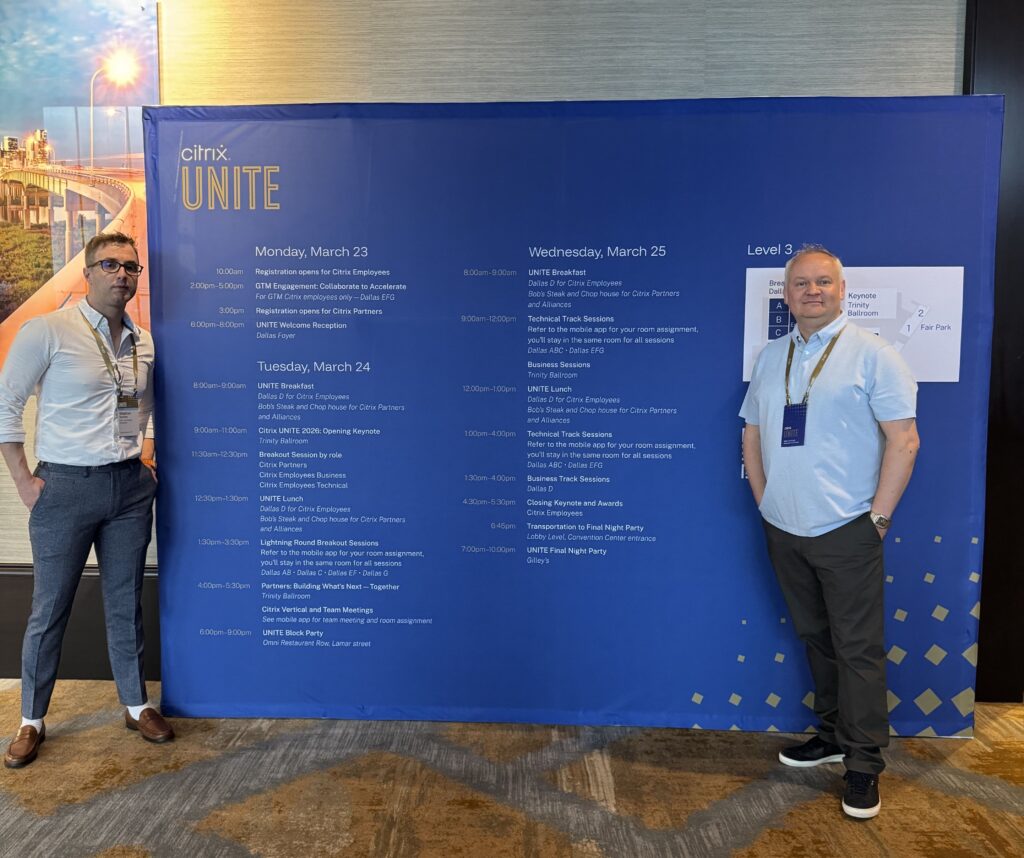
The big takeaways: Citrix is evolving beyond VDI into a full end-user computing platform. Aidrien (their new AI admin tool) is now generally available, and it’s going to impact how environments are managed.
NetScaler is quietly powering some of the most critical infrastructure on the planet. XenServer is gaining serious momentum with VMware customers, and Veeam support is weeks away.
The AI agent story is fascinating; Citrix has been providing the guardrails for remote workers for 30+ years, making them perfectly placed to fulfil that same role for AI agents.
Oh, and the persona-based approach to driving down cloud VDI costs is something every organisation running workloads in the cloud needs to be looking at.
Setting the Tone: Confidence, Not Hype
The theme this year was “Big. Bold. Earned.” and it landed. This wasn’t a company trying to convince the room it had a plan; this was a company showing the receipts.
The Cloud Software Group CEO, Tom Krause, opened with a candid reflection on the three years since it acquired Citrix. He acknowledged that Citrix had drifted from its core and needed to re-earn trust with customers and partners. That kind of honesty set the tone for everything that followed.
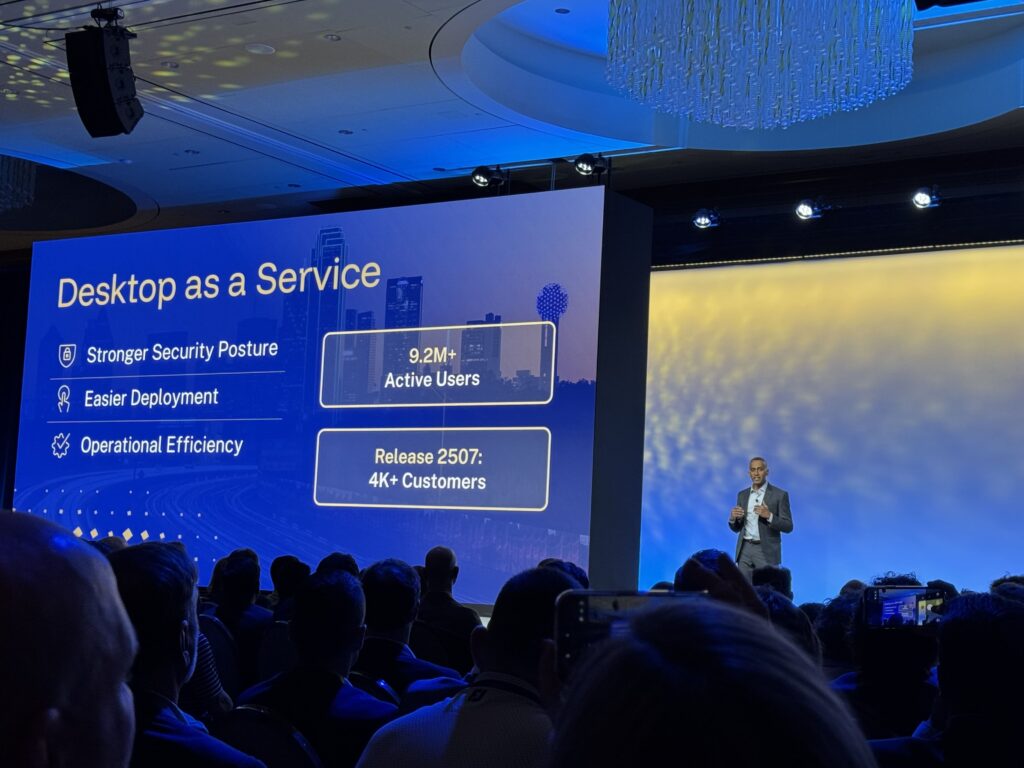
What came next was a clear articulation of Citrix’s move from a pure VDI company to an end-user computing platform company. That distinction matters — it’s not about abandoning the desktop, it’s about recognising it as one access method among many. The numbers back it up. The platform has grown to 9.2 million active desktop users, roughly double the figure from a few years ago. The engineering team delivered over 500 customer-requested enhancements during this cycle. Gartner has ranked Citrix number one across all key use cases in their Critical Capabilities report for three consecutive years.
AI Agents: My Biggest Takeaway from the Whole Event
I believe Citrix has a massive role to play in the AI story; this was probably my single biggest takeaway from UNITE.
Right now, most of us are running AI agents on our own desktops. They’re using our keyboard, our mouse, our session, our credentials. And that creates a real tension: how do you let an AI agent do its job without giving it the keys to everything you have access to?
Citrix’s answer: Give the AI agent its own workspace. Let it operate on a keyboard and mouse that isn’t yours, in an environment where you can see exactly what it’s doing, control what it can reach, and revoke access the moment something goes wrong.
The knock-on effect of this is huge. When the AI agent runs in its own managed workspace, you can implement proper guardrails (identity, governance, session recording, data access policies) without preventing the agent from doing what it does best – letting it operate safely at full speed.
And here’s the thing that really clicked for me: Citrix has been doing exactly this for over 30 years. The technology, the policies, the operational muscle, it all already exists. It’s just being applied to a new type of worker.
That’s what makes Citrix’s position in the AI agent space so compelling. As enterprises start deploying AI agents at scale (which is coming faster than most people think), the need for this kind of control plane is going to be enormous.
Aidrien: Your New Favourite Admin Tool
Aidrien is Citrix’s agentic AI capability, and it’s now generally available to all Citrix customers. It’s like an admin assistant that never forgets, and never complains about being asked to check something at 3 am.
The pitch is simple: Citrix environments are complex, talent is scarce, and admin teams are stretched thin. Aidrien is designed to lower administrative barriers, optimise user experience, and take the grunt work out of environment management. It can surface issues before they become tickets, recommend optimisations, and help teams who are drowning in operational overhead get ahead of the curve.
Aidrien creates a natural conversation about maturity. Most customers are still running their Citrix estates reactively. Aidrien gives you a reason to talk about operational transformation, to look at enablement, optimisation, and ongoing improvement rather than just keeping the lights on.
Combined with uberAgent (now fully integrated into the platform for experience monitoring and persona mapping) and deviceTRUST (embedded for endpoint security posture), you’ve got a stack that can tell you who your users are, what they’re experiencing, whether their device is trustworthy, and how to make the whole thing run better. That’s a proper story.
NetScaler: The Beast Nobody Talks About Enough
I’ll be honest, NetScaler doesn’t always get the headline billing at these events. But the session on mission-critical deployments was one of the highlights of my entire week.
NetScaler is critical infrastructure for some of the world’s biggest enterprises, from emergency services running their contact centre screens to logistics companies feeding sensor data from trains and trucks into safety systems.
To put it another way: this is not a niche product.
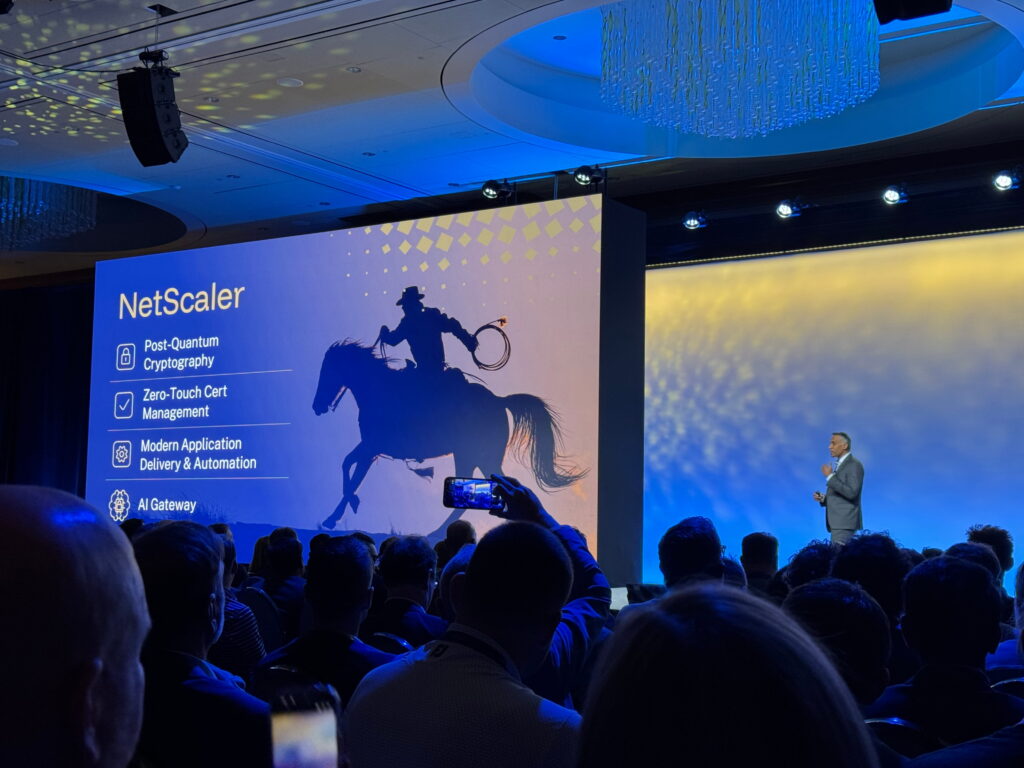
Its strategic direction is what really caught my attention. NetScaler is evolving in three important ways. First, automation to reduce operational costs. At this scale, labour dominates the total cost of ownership far more than licenses do.
Second, AI governance capabilities. They open the door to executive-level conversations about how AI traffic is managed, secured, and governed as it flows through the enterprise.
Third, a deliberate push from point solution to wall-to-wall platform adoption. A typical enterprise runs thousands of applications. A single NetScaler supports 50 to 100 of them. It’s a great opportunity to expand within existing accounts, and the Universal SKU makes cross-selling across the Citrix portfolio easier than ever.
NetScaler is also making serious moves on the infrastructure front, with innovations in post-quantum cryptography readiness, AI gateway preparation, and cloud application delivery automation. For anyone still thinking of NetScaler as “just a load balancer,” it’s time to update that mental model.
If NetScaler isn’t part of your conversation yet, now’s the time to change that.
XenServer: The VMware Alternative That’s Actually Delivering
Let’s start with the big structural changes. Feature gating is gone. Now there’s one edition available to every customer, with nothing held back.
Then there’s the new release cadence. XenServer has moved away from monolithic updates to smaller packages landing every three to six weeks. Customers get full control over when they adopt. This means they get innovation faster without being forced into upgrades they don’t need.
XenServer 9 is now in public preview, built on an entirely new kernel, and the early signals are seriously encouraging. Their largest customer has been testing it and is actually asking to go into production use before formal GA. That tells you something about the quality.
Now here’s the bit that got the room excited. Veeam integration is targeted within weeks. For anyone who’s had the “but what about backup?” conversation when positioning XenServer, that objection is about to disappear. Veeam support is part of a broader push to strengthen the partner ecosystem, with similar efforts underway for other backup vendors, alongside expanded hardware partnerships with Cisco and HP.
The VMware displacement opportunity is real and accelerating. Over 1,000 customers are already migrating from VMware, and partners shared examples of large-scale core migrations completed on existing hardware in as little as eight weeks. Healthcare is a particular bright spot, with Epic hosting and self-hosted customers significantly increasing their XenServer usage. GPU workloads now make up roughly 18% of deployments, reflecting the growing demand for AI and CAD/CAM use cases.
Citrix isn’t claiming XenServer will replace everything. The message is that for 70 to 80% of virtualisation workloads, XenServer can do the job brilliantly and cost-effectively. Keep your specialist platforms for databases or niche requirements. But for the bulk of your estate? XenServer is a serious, production-proven option. And given the VMware licensing landscape, a lot of customers are ready to have that conversation right now.
Partnerships That Actually Mean Something
Citrix and AWS continue to deepen their collaboration around Workspace Core. Multi-cloud isn’t a buzzword; it’s a regulatory and operational reality. Enterprises need the freedom to place workloads where governance, security, and sovereignty demand, and the Citrix-AWS combination delivers that with production-grade maturity expanding towards all 39 AWS regions.
Citrix and Google announced an expanded partnership around the enterprise browser. The shift from browsers as consumption tools to browsers as creation platforms (driven by AI agents, progressive web apps, and modern development workflows) fundamentally changes the security calculus. The joint effort between Citrix Secure Access and Chrome Enterprise Premium is targeting regulated sectors like healthcare and financial services, in a genuine product integration story, not just a co-marketing agreement.
The Vertical Play: Healthcare and Financial Services
Citrix has committed to a vertical-first strategy, and they’re putting real investment behind it. In healthcare, they’ve hired a field CTO, Cletis Earle, with deep provider-side experience (a former CIO and past CHIME chairman), brought on a dedicated marketing resource, and engaged external consultancies to educate their own teams on the regulatory and operational realities of the sector.
The message was clear: if you want to win in healthcare or financial services, you need to understand HIPAA, DORA, SWIFT, clinical desktop workflows, and payer economics, not just product features. The sessions on verticalization were among the most practical of the event, with real case studies showing how Citrix has enabled healthcare systems to reduce update cycles from weeks to overnight, support rapid site integrations, and deliver secure EHR access at scale.
The Imprivata integration for healthcare is maturing nicely, too. After building the foundation and achieving certification last year, the focus has shifted to converting proof-of-concept deployments into production, addressing real clinician pain points like slow logins and fragile shared-device workflows.
Personas at the Centre (And Why Your Cloud Bill Will Thank You)
If you’ve worked with customers running VDI in the cloud, you’ve seen the same pattern I have: everyone gets the same persistent desktop, the same compute, the same storage profile, regardless of what they actually do all day. Then the invoice lands, and it’s significantly higher than anyone planned for. It’s common, and almost always fixable.
A consistent thread throughout UNITE was the concept of personas as the answer to this problem. Not every user needs the same thing. A call centre agent taking calls off a script doesn’t need the same compute as a financial analyst crunching models in Excel.
When you map your workforce properly, right-sizing compute, persistence, and access modality to how people actually work, the cost savings are significant. We’re talking about customers who run 2,000 users on identical persistent desktops, who discover that half of them could use pooled or browser-only sessions at a fraction of the cost. That’s real money back in the budget.
What makes this practical rather than theoretical is the tooling. Deploy uberAgent first to collect actual usage data across your estate, then run persona assessments based on what people are really doing rather than what someone assumed they were doing three years ago. deviceTRUST layers in endpoint security posture so you can make access decisions based on real-time signals. And Aidrien helps optimise the whole thing on an ongoing basis. It’s persona discovery and mapping as a data-driven exercise, not a whiteboard guessing game.
For me, this is where some of the most valuable work happens. Being able to walk in with a persona assessment, backed by real tooling, and show them exactly where they’re overspending and what to do about it? That’s the kind of conversation that builds long-term relationships.
Secure Developer Spaces
A quieter but still important topic was Secure Developer Spaces (SDS). These centralised, cloud-based development environments can either replace traditional VDI for developers or optimise it. The cost savings are substantial, and the security model addresses real pain points around external developer onboarding, Linux workflow support, and GenAI development environments.
For enterprises with large developer populations, particularly in regulated industries with strict IP protection requirements, this is a meaningful addition to the conversation.
M&A: Why Citrix Makes Day 1 and Day 2 Actually Work
The CIO perspective on M&A — featuring Cloud Software Group’s own CIO, Saikat Pattadar, talking through how they’ve used Citrix internally during acquisitions — was one of the sessions I hadn’t expected to be so compelling. It properly clicked for me why this is such a natural fit.
When a deal closes, you have what’s called Day 1: thousands of employees and contractors at the acquired company need secure access to systems and applications immediately. If those people can’t work, the deal starts leaking value from the moment the ink dries. One stat that stuck with me: 80% of deals that ultimately lost value had no technology integration plan at the point of signing.
Citrix solves Day 1 because it’s what the platform was built to do. Spin up a workspace. Define personas for the incoming workforce (employees, contractors, different roles). Assign the “birthright” applications that each persona needs to be productive. Layer on security controls like URL filtering, DLP, and secure private access to ERP and finance systems, so acquired users can reach what they need without being exposed to the full network. The real-world example shared at the session was impressive: planning started in late November, and they went live in early December. Going from SPA deployment to production took about a week. That’s not a theoretical capability; that’s a CIO describing what actually happened.
What makes it work is the security model. During an acquisition, you’re dealing with unknown identities, unknown devices, unknown networks, and overlapping tech stacks. You need segmented access where acquired users get exactly what they need and nothing more, all governed by policies that Citrix has been enforcing for decades.
Then there’s Day 2: harmonising systems, consolidating identities, detangling redundant networks and applications. This is where most organisations get bogged down. The Citrix platform gives you a stable access layer that doesn’t need to change while everything underneath is being rationalised. Users keep working through their Citrix workspace while the backend migration happens around them.
The numbers are worth noting: M&A integrations are completing up to 40% faster when Citrix is pre-positioned, per-user costs are reduced by 35 to 50% through right-sized personas, and divestiture timelines are cut by up to 60% when the environment is already designed to be separable.
If you build your environment to be “divestiture ready” from the start, with clean identity domains, application segmentation, and clear data boundaries, then when the business decides to sell a division, IT isn’t the bottleneck.
For me, this session reframed Citrix as something much bigger than a desktop delivery platform. When a CIO can walk into a board meeting and say, “my technology platform saved us months on integration and millions in duplicated infrastructure,” that’s a completely different conversation from anything we’d normally have about VDI.
Platform Performance and Security
Security has moved from slogan to substance. The platform is working towards FedRAMP High certification for Citrix Cloud, and the 2025 platform update delivered measurable performance improvements, with customers independently validating gains that exceeded Citrix’s own expectations. At scale, that translates directly into infrastructure cost savings.
The HDX protocol continues to be a genuine differentiator too. It’s the thing that makes the user experience feel native even when the compute is running hundreds of miles away. Combined with Aidrien’s capabilities, you’ve got a platform that doesn’t just work, but gets better over time.
What I’m Taking Away
Citrix UNITE 2026 left me more confident in the platform direction than I’ve been in a long time. The announcements, stories, and expanded partnerships added up to a genuinely compelling story.
But the real work starts now. The industry needs to invest in persona-based discovery and advisory capabilities. Everyone needs to get comfortable with having business-outcome conversations rather than feature-function debates. And production adoption, not just proof of concepts, needs to be the measure of success.
The theme was Big. Bold. Earned. The first two were on display in Dallas. The third is what we all need to go and do.
Axess Systems is one of only five Citrix Preferred Service Partners in the UK. That means we’re up to speed on all the latest Citrix developments – and are ready to help you make the most of them.
To learn more, give us a call on 01773 88260 or email [email protected].
 Previous